The EU budget can be more efficient without raising taxes.
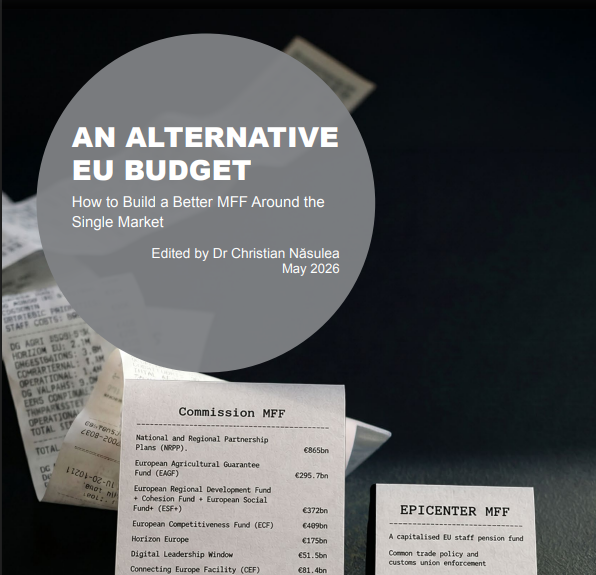
The Institute of Economic and Social Studies (INESS), together with prominent European think tanks united in the pan-European EPICENTER Network, has published a proposal for an Alternative EU Budget for 2028–2034. Based on our expenditure analysis, we argue that the EU’s multiannual budget can meet its intended goals through more efficient spending, without the need to introduce new taxes or increase existing revenue sources. The Slovak version of the document is available at this link.
A detailed analysis in English is available at this link. An interactive website on this proposal can be found at An Alternative EU Budget website.
Starting points
- The primary purpose of the EU budget is to support the functioning of the single market and the free movement of goods, services, capital, and people — not to replicate national fiscal systems.
- A strict legitimacy test should apply: spending at EU level is justified only where it demonstrably supports the free movement of persons, goods, services, or capital — that is, where it reduces cross-border barriers or delivers outcomes that member states cannot achieve on their own.
- Redistribution, or sector-specific spending within national economies, falls outside this core function.
Findings
The composition of budget spending is increasingly out of step with the core functions of the single market:
- Cohesion policy and agricultural policy remain dominant, even though they serve primarily as redistribution rather than as a remedy for cross-border market failures.
- Newer areas (clean energy, industrial policy, external action) are expanding EU intervention without clear justification, bypassing the requirement of subsidiarity. The revenue-side proposals (CORE, TEDOR, a tax on electronic waste, ETS allocations) are inconsistent: they threaten the competitiveness of the single market, fail to preserve fiscal neutrality, and risk increasing the tax burden without improving the allocation of resources.
- Long-term competitiveness would be better served by reducing the regulatory burden and deepening the single market than by further fiscal centralization.
Proposals
Expenditure
- Do not increase the budget’s overall spending; keep it at around 1% of EU GNI (€1.5–1.6 trillion for 2028–2034), roughly €220–230 billion less than the Commission’s proposal.
- Prioritize spending with clear European added value, such as cross-border transport infrastructure, energy interconnections, targeted research, and outcome-based educational mobility (Erasmus+).
- Apply a strict subsidiarity test to cohesion and agricultural programmes; scale them back or reorient them wherever action at national level would be more effective.
- Replace centrally defined targets and ceilings with outcome-based delivery that respects the autonomy of national policies.
- Reform the pension liabilities of EU staff: shift from a pay-as-you-go system to funded savings, in order to reduce costs and support capital markets.
Revenue
- Rely on a limited number of clearly defined member state contributions tied to capacity, rather than on multiple new own resources.
- The new revenue sources proposed were not selected on the basis of coherent fiscal logic, but rather for their political feasibility.
- With the exception of CBAM, the proposed new revenue sources carry uncertain tax yield (the e-waste tax), reduce the competitiveness of the EU economy (CORE), send distorted economic signals by penalizing firms for growth, and strip states of resources they could otherwise use to address costs of their own (such as the costs of smoking or of decarbonization).
- We propose not introducing CORE (a corporate tax based on turnover) or TEDOR (centralization of tobacco excise duty), as both distort incentives and lack a clear link to EU functions. Nor should an e-waste tax be introduced, as this issue falls within the competence of national governments. ETS allowance revenues should not be transferred to the EU budget, but should remain with member states, since they are best placed to manage the costs of decarbonization themselves.
- We propose preserving revenue neutrality: any increase in revenue at EU level must be offset by a corresponding reduction in national contributions or taxation.
The full study is available in English, or in Slovak translation.