When politicians debate public spending, the numbers thrown around are in the hundreds of millions, even billions of euros. Few of us have any real, personal frame of reference for sums that large. Billions are simply too abstract to picture, let alone reason about — and as a result, we lose track of what things actually cost us.
And this is precisely where the educative webpage The Price of the State can be of great help. Every person can simply learn how much the state collects on individual taxes, and one can even easily calculate how much he or she contributes to the running of the state. It is therefore about making the information available to the masses that politicians are so fond of disguising.
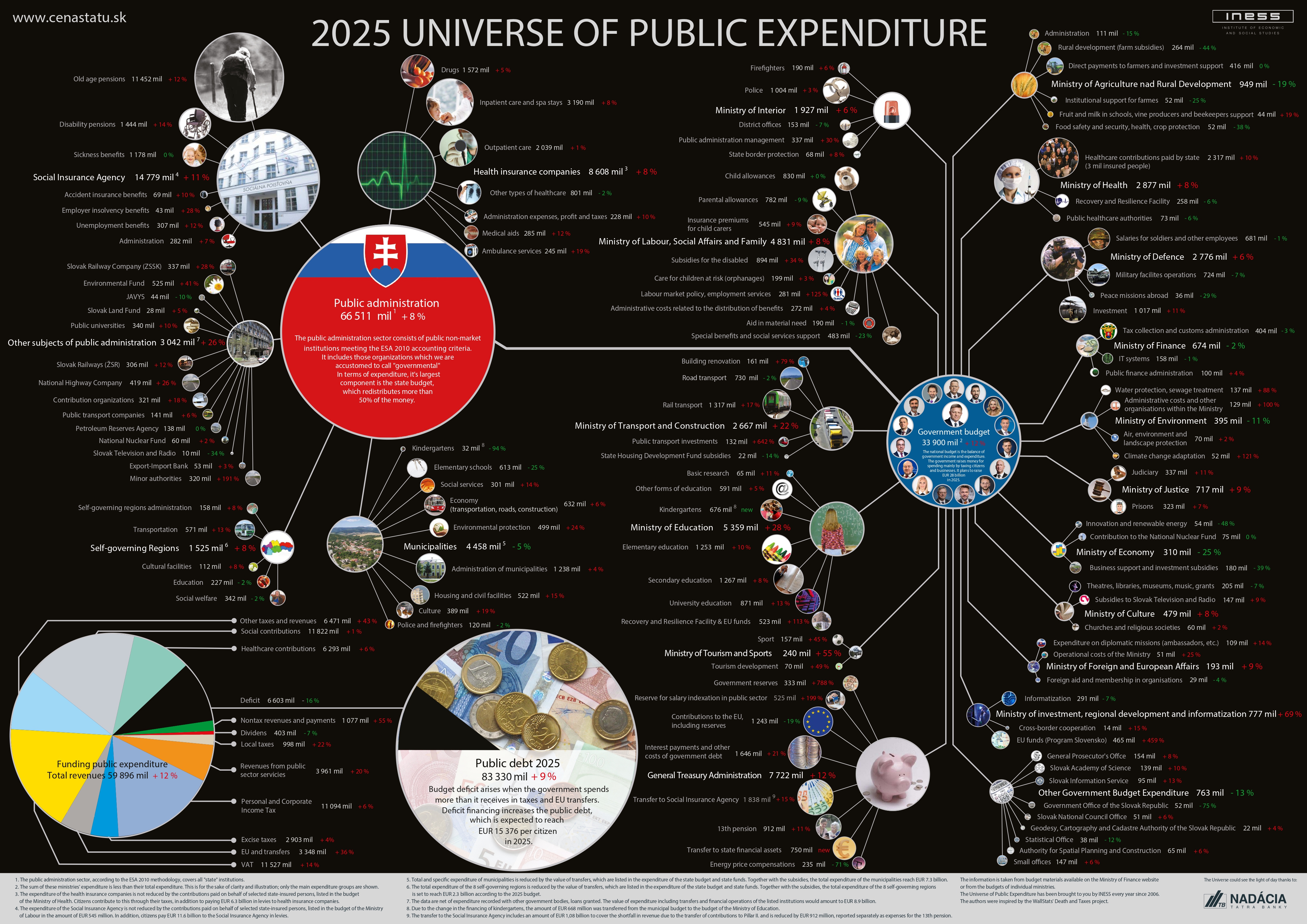
Its centerpiece is the Public Expenditure Universe, a graphic representation of all public spending funded through taxes and levies. Each spending category is shown as a circle sized proportionally to its share of the budget, making it easy to see at a glance how much politicians have spent on any given area, while also revealing how the different parts of public administration relate to one another. In 2006, Slovakia’s Ministry of Education approved the tool as an official teaching aid for economics classes in secondary schools.
The project also includes an annual Receipt for government services, which shows every citizen exactly how much they paid in taxes, and precisely what the state spent that money on.
For voters, this information is essential: without it, it’s hard to judge rationally whether politicians should be raising, cutting, or redirecting public spending. Price of the State makes these numbers visible and understandable – giving voters a tool to hold political spending decisions to account.