Odpovede Juraja Karpiša z INESS na otázky ohľadom dopadov
zavedenia eura na slovenské hospodárstvo v čase krízy zverejnil japonský
časopis Europe Magazine on Japan v júni tohto roku.
Pod scanom z
japonského časopisu nájdete aj jeho transkript v angličtine.
 |
The
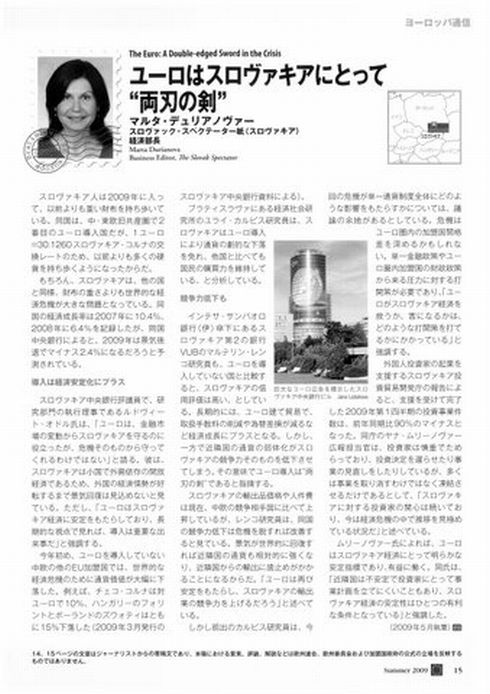
euro – a double-edged sword in the crisis
By Marta Durianova
The Slovak Spectator
Since the beginning of this year Slovaks
have been getting used to heavier wallets. Since switching from Slovak crowns
to the single European currency at a conversion rate of 30.1260 crowns for one
euro, they have had to carry noticeably more coins than before. Slovakia became the second post-communist
country in central and eastern Europe (after Slovenia, in 2007) to adopt the
euro.
However, just like the rest of the world, Slovakia is now
more occupied by the global economic crisis than by the weight of its citizens’ wallets.
The country’s impressions from its initial experience with the euro have been
overshadowed by gloomy forecasts about its economic development. Slovakia
recorded economic growth of 10.4 percent in 2007, and 6.4 percent in 2008.
However, for 2009, the National Bank of Slovakia predicted that the Slovak
economy would enter recession, and contract by 2.4 percent.
As to whether the euro will help or harm
Slovakia in dealing with the consequences of the crisis, most economic analysts
agree that it is too early to judge.
“The euro helped to protect Slovakia from turbulence on the financial market
but the new currency cannot be expected to be an efficacious anti-crisis
remedy,” said Ludovit Odor, a member of the Bank Council of the National Bank
of Slovakia,
the country’s central bank, and its executive director for research.
Slovakia
is a small and a very open economy, he added, and that is why it is
significantly dependent on foreign demand. Until the situation abroad begins to
turn around, Slovakia
cannot expect better times either, according to Odor.
“The euro brings stability for Slovakia and
the adoption of the euro should be understood as a significant event more from
the long-term prospective,” he added.
At the beginning of this year, in response
to the global crisis, the national currencies of other central European
countries which, like Slovakia,
are members of the European Union, but which have not yet adopted the euro,
weakened significantly. The Czech crown, for example, weakened by 10 percent
against the euro, while the Hungarian forint and the Polish zloty both declined
in value by 15 percent against the euro, according to a National Bank of
Slovakia study published in March this year.
Thanks
to the euro, Slovakia did not experience any dramatic decline in the strength
of its currency and the euro maintained the purchasing power of citizens’
savings in comparison to other countries, said Juraj Karpis, an analyst with
the Institute of Economic and Social Studies in Bratislava.
Martin Lenko, an analyst with VUB bank, a
branch of Intesa Sanpaolo, said the euro also brings a better credit rating
compared to those countries which do not have the single currency. From the
long-term perspective it supports the country’s growth through lower
transaction costs, elimination of foreign exchange risk and by supporting
trade.
However, the euro can be seen as a
double-edged sword, said Lenko, because the weakening currencies of the
neighbouring countries have also reduced Slovakia’s competitiveness.
The prices of Slovak exports and labour
have now increased relative to those from its central European rivals.
According to Lenko, Slovakia’s worsened
competitiveness should, however, improve once the crisis is over. As and when a
global economic recovery begins, the neighbouring currencies should start to
strengthen and this will put a brake on their exporters.
“The euro will then, once again, provide
stability and will improve the competitive position of Slovak exporters,” said
Lenko.
However,
it is also open to question how the crisis will impact the whole project of the
single currency, added Karpis. The crisis might deepen the differences among
eurozone members. The pressures arising from the single monetary policy and a
number of independent fiscal policies among eurozone members will require a
solution, according to him.
“And
whether the euro will help or harm the Slovak economy will also depend on what
this solution is like,” Karpis said.
The Slovak Investment and Trade Development
Agency, which assists foreign investors to establish businesses in Slovakia,
reported that the number of investment projects completed with its assistance
dropped by 90 percent in the first quarter of 2009, year-on-year.
Investors are more careful and hesitant,
some are postponing definite decisions about their investments, and some are
revising their projects, said Jana Murinova, the agency’s spokeswoman. However,
most of them are not cancelling their projects but freezing them.
“This suggests that investors’ interest in Slovakia
continues but that they are just waiting to see how the situation develops in
terms of the crisis in the global economy,” Murinova said.
According to her, the euro is a clear
signal of the Slovak economy’s stability and can help.
“The volatility of the currencies of the
neighbouring countries temporarily means that their labour and production costs
are cheaper,” Murinova said. “However, this is not expected to last over the
longer period, which makes it very difficult for investors to make plans. Thus
the stability of the Slovak economy is an advantage.”